FMCG product research
Real shoppers.
Real insights.
Real early.
See how your new product concept performs against its category competitors for real - before you make any development investments.
Check out Fake Supermarket.

Be sure... before.
Let's say your team is working on a new product concept... How much will you invest before you're sure shoppers will want it?
The catch is that the real pressure test only comes after the product reaches the retail shelves... once the bulk of your development and manufacturing budget is already spent.
Start product testing with just an idea.
-
What you bring.
Start with the product concept you want to test, the category competitors it should appear alongside, and the kinds of shoppers you want to hear from.
You don’t need a finished product. A realistic product image and ecommerce listing are enough to put the concept into context and start testing it early.
-
What shoppers do.
Research participants shop the product category, based on what they'd choose for their own household. They choose from your concept and the established products around it.
Along the way, Fake Supermarket tracks what attracts attention, what gets considered, and what ultimately gets put into a cart. A follow-up survey then asks relevant questions about the decisions that each participant made.
-
What you learn.
Once the study is complete, Fake Supermarket brings those behavioural and survey signals together to highlight patterns within audience segments.
Pinpoint where your concept performed strongly, where it under-performed, how different groups of participants responded, and what that evidence suggests about your next product decision.
Fake supermarkets aren’t new. Ours is better.
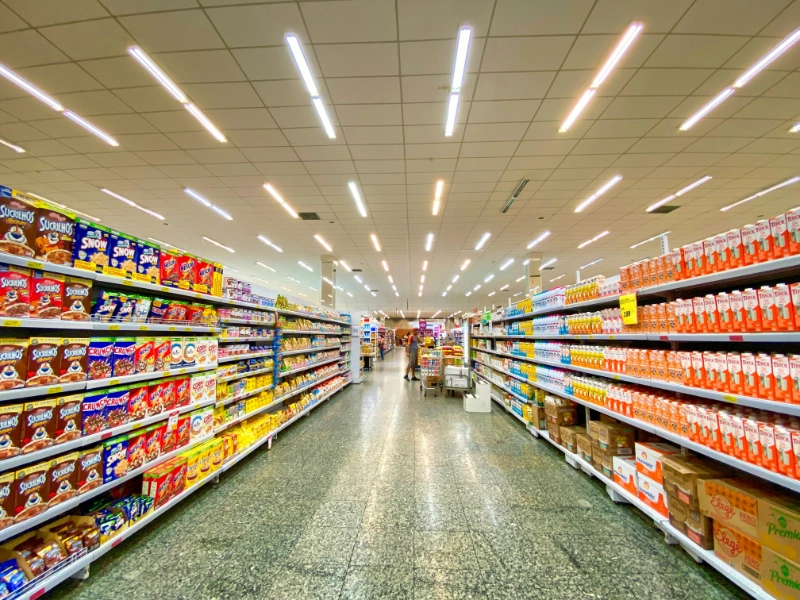
Physical mock supermarkets have been used in consumer research since the 1960s and 1970s.
Back in the day, they'd put a new product on the shelves alongside familiar competitors. Research participants would come through with a shopping cart, and researchers would carefully observe which products caused shoppers to react.
The approach brought valuable realism to product testing. But physical mock stores were expensive to run, cumbersome to change, and geographically constrained. Crucially, a new product had to be produced to a commercial standard. Research results came far too late in the development process to be useful.
Our modern Fake Supermarket preserves the methodological pattern while replacing the physical store with contemporary ecommerce, remote participation, and precise behavioural data.

Decision-grade confidence... usefully early.
Physical mock supermarkets could deliver confidence.
They just delivered it too late.
The strength of physical mock supermarkets was simple: shoppers had to choose between real alternatives. The catch was that putting a physical product on those shelves meant manufacturing it to a shelf-ready standard. By then, it was already too late to make useful course corrections based on how shoppers responded.
Fake Supermarket brings that pressure test forwards. Get performance insights while there's still time to refine the concept, rethink the audience, or change course... before you sign off on the development investment.
Compete for attention against familiar favourites.
FMCG product research often asks shoppers what they think of a product. In Fake Supermarket, it has to compete for their attention alongside established products.
Research participants aren't imagining what they might buy. They're 'shopping' for their own household, from a category they actually need.
Attention and choice sometimes tell different stories.
Every product in the category creates context: What caught their attention, what got ignored, what got put into the cart. All of the signals that reveal whether you've got a compelling proposition.
Pinpoint where participants hesitate over their usual choices — and whether your concept can interrupt their familiar preferences.
Every choice creates a question worth asking.
A follow-up survey uses branching logic to pose sensible questions to research participants. Why did they choose your product? Why didn't they? Did they even notice your product?
What shoppers say becomes so much more useful when you pair it with their organic unprompted product choices.
More confidence. Less guesswork.
One shopper's choice tells you something. Hundreds let you look for patterns. Compare how your concept performs across different groups of shoppers, or combine characteristics to explore more specific audiences.
Use those differences to sharpen the proposition, rethink the audience, refine the product, or decide whether it's worth pursuing at all.
The point of all this evidence is to inform the expensive decisions while they're still easy to change.


Questions with answers.
How finished does the product concept need to be?
If you have a realistic product mock-up and enough information to create a convincing ecommerce listing, you have enough to start testing. Fake Supermarket is designed to generate useful shopper evidence while packaging, positioning and other expensive decisions can still be changed.
What kind of outcome does a study produce?
A completed study gives you evidence of how your product concept performed against its category competitors: whether shoppers noticed it, considered it and chose it — and what they told us afterwards.
We'll surface the patterns across the study and help you explore where those results change between different groups of shoppers. The goal isn't a simple pass or fail. It's stronger evidence for the decisions that come next: what to refine, who your product appeals to, and whether the concept is worth backing further.
Do research participants know which product is being tested?
No. Your concept appears alongside established products in its category, without being identified as the focus of the research. Participants are given a representative shopping task rather than being directed towards your product, so it has to genuinely compete for their attention and choice.
What if participants don't choose my product?
That's useful evidence too. We can see whether research participants noticed or engaged with your product, what they chose instead, and where their shopping behaviour took them. A follow-up survey then explores the reasons behind those choices. Understanding why a product under-performed can be just as valuable as meeting expectations.
Every study also produces a broader view of category performance. Not just how your concept performed, but how research participants responded to the familiar, established products around it.
How many participants does a study need?
It depends on what you want to learn. Fake Supermarket sizes studies around the amount of useful product evidence you need — particularly if you want to look beyond the headline result and compare different groups of research participants. More specific analysis generally requires a larger study.
Can I analyse different kinds of shoppers separately?
Study results can be explored across recruitment characteristics such as age, gender, household structure, income and geography — and combined to investigate more specific audiences. The deeper you go, the less evidence remains in each group, so we'll help you plan a study with enough data to support the analysis that matters to your team.
Be sure, before.
Our core principle applies to us, too.
Before you commission a study with Fake Supermarket, be sure about what we can tell you, what we can’t, and whether our work is the right fit for the decisions in front of you.
Tell us what you’re working on. We’ll help you work out whether Fake Supermarket can help.
-
Real shoppers.
-
Real insights.
-
Real early.